Last Updated: August 2026
QNET is one of the better-known companies operating in the direct-selling and network-marketing space. It is also a company that has generated considerable discussion online, particularly in India.
Search for “QNET scam,” “QNET review,” “QNET pyramid scheme,” or “QNET India”, and you will encounter very different opinions.
Some people describe QNET as a legitimate direct-selling business with products and services. Others describe negative experiences involving distributors, payments, recruitment or income expectations.
So which version is accurate?
The answer requires more than a simple “yes” or “no.”
QNET describes its business as a combination of e-commerce and direct selling. According to QNET’s published explanation, customers can purchase products as consumers or become Independent Distributors. QNET states that commissions are associated with product and service sales and are not paid merely for referrals.
At the same time, consumers in India need to understand the regulatory environment surrounding direct selling and distinguish the company’s official business model from allegations involving individual distributors or representatives.
India’s Consumer Protection (Direct Selling) Rules, 2021, together with the 2023 amendment, provide the central regulatory framework for direct-selling businesses. The Government of India’s Department of Consumer Affairs publishes both sets of rules on its official website.
This QNET review examines:
- What QNET is
- How QNET works
- QNET’s products
- How the compensation model is described
- Whether QNET is a job
- Whether QNET is an investment
- QNET and pyramid-scheme questions
- QNET’s position on scam allegations
- QNET’s Indian operations
- Recent controversies and allegations
- India’s direct-selling regulations
- How prospective distributors should evaluate the opportunity
Editorial note: This article distinguishes between company statements, government regulations, reported allegations, investigations and established facts. An allegation, complaint, FIR or police investigation should not automatically be interpreted as a final finding of guilt.
Quick QNET Facts
| Question | Answer |
|---|---|
| What is QNET? | A company that describes its business as e-commerce combined with direct selling |
| What does QNET sell? | Products and services across areas including wellness, lifestyle and other categories |
| Who can buy QNET products? | Consumers can purchase products without necessarily becoming distributors |
| Who is an Independent Distributor? | A person participating in QNET’s business opportunity independently rather than as an employee |
| How does QNET say distributors earn? | Through qualifying product/service sales under its compensation plan |
| Is QNET a traditional job? | No |
| Does QNET describe itself as an investment scheme? | No |
| QNET’s Indian franchise company | Vihaan Direct Selling India Pvt Ltd, according to QNET’s India information |
| Does India regulate direct selling? | Yes |
| Are pyramid and money-circulation schemes permitted under India’s direct-selling framework? | No |
| Should consumers verify income claims? | Yes |
What Is QNET?
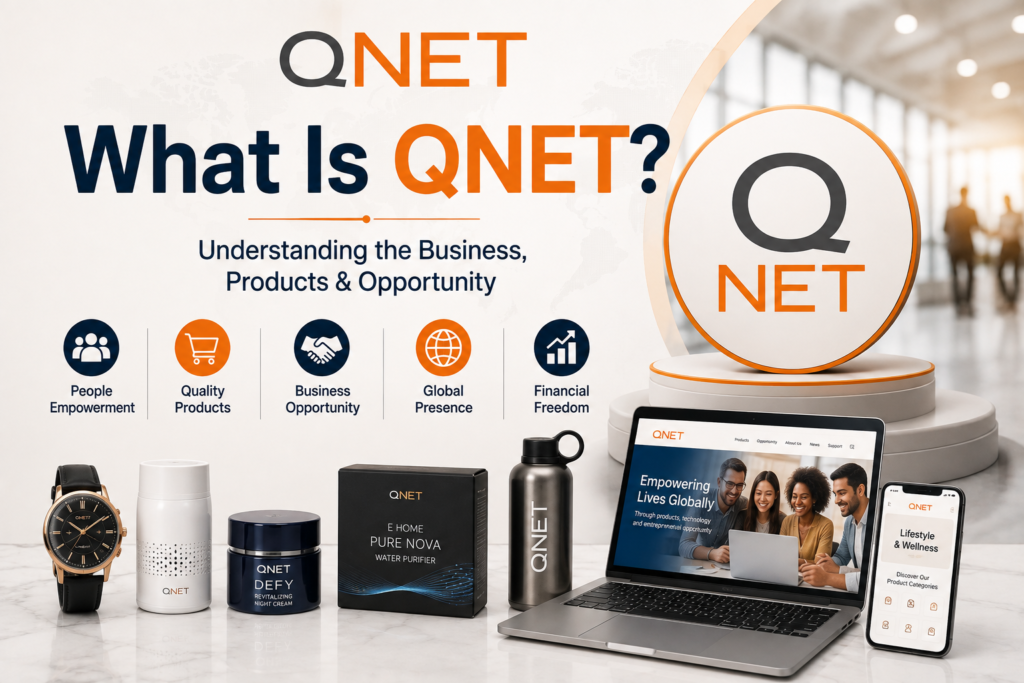
QNET describes itself as a global direct-selling company that combines e-commerce with direct selling.
The basic structure is relatively straightforward.
A customer can purchase products or services through QNET. According to QNET, that customer may remain a consumer or choose to become an Independent Distributor and participate in the business opportunity.
QNET states that Independent Distributors can earn commissions from qualifying sales of products and services, including sales to direct referrals and sales associated with their teams under the company’s compensation plan. The company specifically states that commissions are not paid simply for referrals.
This distinction is important because many people use the terms direct selling, MLM, network marketing and pyramid scheme interchangeably even though they can describe very different structures.
If you are new to this industry, it is useful to first understand the difference between a legitimate direct-selling model and a pyramid scheme. You can read NetworkerTalk’s guide on direct selling and pyramid schemes before evaluating any particular company.
How Does QNET Work?
According to QNET, its business combines two elements:
E-commerce + direct selling
A simplified representation looks like this:
Products/services → customers → sales → Independent Distributors → qualifying commissions
QNET says customers have the option of simply purchasing products or participating as Independent Distributors.
For distributors, the company explains that commissions are connected to product and service sales under its compensation plan.
This distinction matters enormously.
Suppose someone tells you:
“You only have to recruit people and you will automatically make money.”
That statement should be checked against QNET’s official compensation information.
QNET’s own explanation says commissions are paid for product or service sales, not referrals alone.
This is also why prospective distributors should never rely exclusively on a presentation given by an individual distributor.
Read the company’s official documentation and understand exactly what constitutes a qualifying sale.
Is QNET a Job?
No. QNET itself states that its business opportunity is not a conventional job.
According to QNET’s official FAQ, Independent Distributors operate their own businesses and are not employees of QNET. The company provides the platform, products and support, while the distributor is responsible for their own business activity.
That means joining QNET should not be compared directly with accepting a salaried position.
A QNET distributor should not automatically expect:
- A fixed monthly salary
- Guaranteed income
- Employee benefits
- Paid leave
- Guaranteed commissions
- Guaranteed customers
This distinction is particularly important because people sometimes encounter QNET-related opportunities advertised informally as “jobs.”
If someone approaches you with a QNET opportunity and describes it as a guaranteed-salary job, verify the claim independently.
Is QNET an Investment Scheme?
This is another area where consumers need to be particularly careful.
QNET’s official India FAQ says that QNET and Vihaan do not ask customers for investments. It describes the Indian operation as a direct-selling business involving products and services and says customers can either remain retail customers or become Independent Distributors.
QNET says that Independent Representatives earn through product sales.
Therefore, if somebody approaches you and says:
“Give me ₹5 lakh and you will receive guaranteed monthly returns through QNET,”
that should immediately trigger additional verification.
Ask:
- What exactly am I purchasing?
- Where is the official invoice?
- Who receives my payment?
- Is this payment being made through an official QNET channel?
- What product or service is involved?
- Where is the official compensation documentation?
- Is the income guaranteed?
- What is the refund policy?
Never confuse a business opportunity with a guaranteed investment return.
Who Operates QNET in India?
QNET’s published information identifies Vihaan Direct Selling India Pvt Ltd in connection with its Indian operations.
This distinction is important when reading news reports or online discussions.
You may see references to:
- QNET
- Vihaan Direct Selling
- QNET distributors
- Vihaan representatives
- Independent Representatives
These terms should not automatically be treated as identical.
When investigating a specific allegation, identify exactly which person or entity is named in the complaint, FIR, investigation or court proceeding.
For the company’s own current information, readers should refer to the official QNET contact and India information.
What Products Does QNET Sell?

QNET has a broad product and service portfolio.
Depending on market and availability, QNET’s offerings cover areas such as:
- Health
- Wellness
- Nutrition
- Personal care
- Beauty
- Lifestyle
- Home and living
- Watches
- Jewellery
- Travel
- Education
- Technology
QNET’s business information describes the company as operating through a direct-selling model in which Independent Distributors can promote and sell products and earn retail profit and commissions under the company’s plan.
However, the existence of products does not automatically answer whether a particular business opportunity is financially attractive.
That requires a separate evaluation.
Are QNET Products the Main Business?
This is an important question when evaluating any network-marketing company.
A product-based direct-selling business should ultimately have products or services that customers genuinely want.
Consider two scenarios.
Scenario 1: Product-driven purchase
A consumer wants a product and purchases it because the product provides value.
Scenario 2: Opportunity-driven purchase
A person purchases a product mainly because they have been told:
“Buy this, join the business and recruit people so you can recover your money.”
Those are fundamentally different economic situations.
This is why it is useful to examine product pricing independently of the business opportunity.
For additional context, NetworkerTalk’s article on product price ranges in network marketing in India can be used as a comparison resource when evaluating product economics across the industry.
How Does the QNET Compensation Plan Work?
QNET’s published business information describes several components of its distributor earnings, including:
- Retail profit
- Step commissions
- Repeat sales points
- Incentives and bonuses
QNET also states that earnings can be affected by different variables and that distributors should understand their rights and responsibilities.
This means a potential distributor should not interpret a compensation presentation as a guaranteed income statement.
Before joining, ask:
- What is a qualifying sale?
- How is sales volume calculated?
- What are the requirements for commissions?
- What happens when a product is returned?
- Are there maintenance requirements?
- Are there additional business expenses?
- What happens if I have customers but no team?
- What happens if I recruit people but generate insufficient product sales?
These questions are more useful than simply asking:
“How much money can I make?”
Does QNET Pay for Recruitment?
According to QNET’s published explanation, commissions are paid for product and service sales rather than referrals alone.
That distinction is central to understanding the company’s stated model.
However, there is another practical question:
What is the individual distributor telling the prospect?
If a distributor makes claims that do not match QNET’s official information, the prospect should verify those claims directly.
For example, if somebody says:
“There is no need to sell anything.”
or:
“Your income comes simply from recruiting people.”
ask them to show you where that statement appears in the official compensation documentation.
Do not rely solely on verbal explanations.
Is QNET a Pyramid Scheme?
No QNET is not pyramid Scheme. This is one of the most searched questions about QNET.
The answer needs to be carefully qualified.
QNET’s position
QNET describes its business as direct selling and says commissions are based on product and service sales rather than referrals alone.
India’s regulatory framework
The Government of India’s Department of Consumer Affairs lists the Consumer Protection (Direct Selling) Rules, 2021 and the Consumer Protection (Direct Selling) (Amendment) Rules, 2023.
The rules provide requirements for direct-selling entities and address prohibited practices.
What does that mean for consumers?
The key question is not simply:
“Does the company have products?”
Instead, ask:
“How does money actually move through the business?”
A consumer should examine whether the opportunity being presented to them is consistent with the company’s official sales-based model and applicable Indian law.
For a broader explanation, readers can also review NetworkerTalk’s direct-selling and pyramid-scheme guide.
What Does Indian Law Say About Direct Selling?
India does not prohibit direct selling as a business model.
Instead, direct selling operates within a consumer-protection framework.
In India, direct-selling businesses operate within a consumer-protection framework. The Department of Consumer Affairs, Government of India publishes the Consumer Protection (Direct Selling) Rules, 2021, along with the Consumer Protection (Direct Selling) (Amendment) Rules, 2023, which amended the 2021 rules.
The government has also issued compliance-related communication to direct-selling entities. A 2022 Department of Consumer Affairs communication explained that the 2021 rules were notified under the Consumer Protection Act, 2019 and highlighted obligations relating to direct-selling entities and consumer grievance redressal.
For anyone researching QNET in India, these government documents are more authoritative than random social-media posts or anonymous blogs.
External source: Government of India — Consumer Protection / Direct Selling Rules
Why Is QNET Called a Scam by Some People?
There are several reasons QNET has attracted negative discussions online.
These can include allegations or complaints involving:
- Upfront payments
- Income expectations
- Recruitment
- Product pricing
- Refunds
- Distributor conduct
- Business presentations
- Claims about commissions
- Claims about investment returns
But not all online claims have the same evidentiary value.
There is a major difference between:
an anonymous social-media post
and
a documented consumer complaint
and
a police investigation
and
a court judgment.
A high-quality QNET review should therefore avoid treating all negative claims as proven facts.
This is particularly important for a publication such as NetworkerTalk because your goal should be to provide readers with useful evidence, not simply sensational headlines.
QNET’s Response to Scam and Pyramid-Scheme Claims
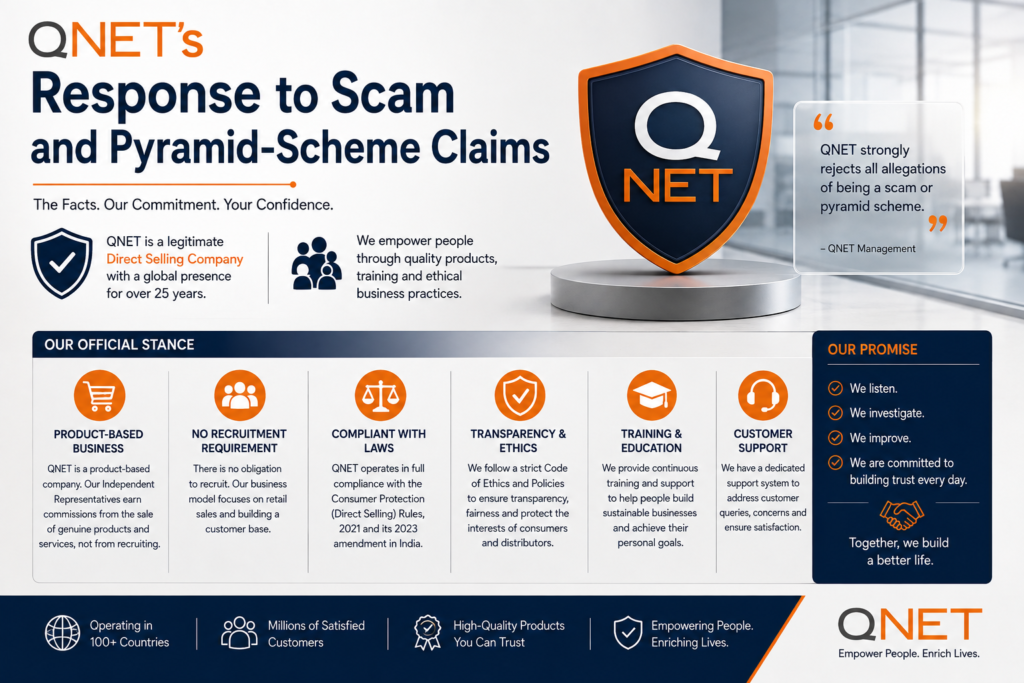
QNET rejects the broad characterization that its business is a scam or pyramid scheme.
Its official business FAQ explains its direct-selling model and specifically states that commissions are paid for product and service sales rather than referrals alone.
QNET also maintains official resources addressing questions surrounding scams, pyramid schemes and fraudulent activity.
That creates an important distinction.
There are potentially three separate things to investigate:
1. QNET’s official business model
What does the company say it sells and how does its compensation system work?
2. Individual distributor behavior
What is a particular distributor promising a prospect?
3. Fraud using the QNET name
Is somebody falsely representing themselves as a QNET representative or using QNET’s name to solicit money?
These should not automatically be treated as the same thing.
What If Someone Says “Invest ₹5 Lakh in QNET”?
This is perhaps the most practical warning in the entire article.
QNET’s official India FAQ says that QNET and Vihaan do not ask customers for investments and says the way an Independent Representative earns money is through product sales.
Therefore, if somebody approaches you and asks for a large amount of money while promising guaranteed returns, do not simply assume that the offer represents QNET’s official business model.
Instead:
Step 1: Ask what you are buying
There should be a clearly identifiable product or service.
Step 2: Request official documentation
Do not rely on screenshots or WhatsApp messages.
Step 3: Verify the payment recipient
Be cautious about transferring money to a personal bank account.
Step 4: Verify the representative
Use official company channels.
Step 5: Read the compensation plan
Understand where commissions actually come from.
Step 6: Ask about refunds
Understand your rights before purchasing.
Step 7: Reject guaranteed-income claims
No legitimate business opportunity should be evaluated solely on promises of guaranteed returns.
Can You Make Money With QNET?
QNET’s official business material says Independent Distributors can earn through retail profit and commissions associated with product sales and the company’s compensation plan.
But that does not mean every distributor will make money.
Actual results can depend on:
- Sales ability
- Customer demand
- Product pricing
- Repeat purchases
- Customer retention
- Distributor activity
- Business expenses
- Time invested
- Market conditions
- Compensation-plan requirements
There is also an important difference between revenue, commission and profit.
For example:
₹50,000 commission
does not necessarily mean:
₹50,000 net income.
A distributor may have legitimate business expenses such as travel, advertising, communication, events and other operating costs.
Anyone considering the opportunity should calculate the economics after expenses.
What About “Financial Freedom” Claims?
This is not unique to QNET.
Financial-freedom language is common across the network-marketing industry.
There is an important difference between:
“This business may provide an opportunity to build additional income.”
and:
“You will earn ₹2 lakh every month.”
The second is a specific income claim.
If someone makes a specific income promise, ask:
- Is the claim officially documented?
- Is it typical?
- Is it gross or net income?
- Does it include expenses?
- How many distributors achieve that result?
- What qualifications are required?
- Is the result independently verifiable?
A photograph of an expensive car is not an income disclosure.
A screenshot of a commission is not proof of typical earnings.
QNET and the Difference Between Company Policy and Distributor Conduct
This is one of the most important distinctions in researching QNET.
A company can have written policies while individual representatives may still make statements that do not comply with those policies.
QNET itself states that its Independent Distributors receive training covering its policies, business model, compensation plan and ethical business practices.
Therefore, if you encounter a distributor making a claim that seems inconsistent with official QNET information, ask:
“Can you show me where QNET officially states this?”
This simple question can eliminate a surprising amount of confusion.
Recent QNET/Vihaan Controversies in India
Recent reporting has included complaints and investigations involving people described as QNET/Vihaan representatives.
These reports should be treated carefully.
For example, The Times of India reported in 2026 on Hyderabad cases involving allegations of payments, commissions, returns and recruitment connected to representatives associated with Vihaan. These reports concern complaints and investigations; they should not be presented as a final court judgment against every QNET operation or distributor. Times of India — Hyderabad Vihaan investigation report
Another 2026 Hyderabad report described a complaint in which a person alleged that he had been induced to make payments through a purported QNET-related investment opportunity. Police reportedly registered a case. Again, this should be described as an allegation and investigation rather than a proven finding. Times of India — Hyderabad QNET-related complaint
A further 2026 report discussed complaints from people who alleged that they had invested money in a QNET-related scheme in Hyderabad. The report described police action following those complaints. Times of India — Hyderabad QNET complaint report
The correct editorial approach is therefore:
Report the allegation → identify who made it → identify what authorities did → explain QNET’s position → avoid presenting the allegation as a final verdict.
What Do the Recent Cases Teach Consumers?
Regardless of the eventual outcome of individual investigations, several consumer-protection lessons are useful.
Be careful with large upfront payments
If someone asks for several lakh rupees, understand exactly what you are purchasing.
Be suspicious of guaranteed returns
A direct-selling business should not automatically be presented as a guaranteed investment.
Verify recruitment claims
Understand whether the opportunity depends on actual product sales.
Verify the identity of the representative
Do not assume someone is authorized simply because they use QNET branding.
Verify the payment channel
Do not send money simply because someone sends you a WhatsApp or Telegram payment instruction.
QNET vs Traditional Employment
| Factor | QNET / Direct Selling | Traditional Employment |
|---|---|---|
| Relationship | Independent business participant | Employee |
| Fixed salary | No guaranteed salary | Usually defined |
| Income | Sales/commission dependent | Salary/wage |
| Employee benefits | Not equivalent to employment | May be provided |
| Flexibility | Potentially higher | Depends on employer |
| Income certainty | Generally lower | Generally higher |
| Sales responsibility | Important | Depends on role |
| Business risk | More individual responsibility | More risk carried by employer |
This is why someone searching for a job should carefully understand what they are actually being offered.
QNET itself says its Independent Distributor opportunity is not employment.
QNET Pros and Cons
Potential Advantages
- Established international brand
- Broad product portfolio
- E-commerce infrastructure
- Direct-selling model
- Independent business opportunity
- Multiple product categories
- Training resources
- Global presence
Potential Risks and Challenges
- Income is not guaranteed
- Business performance depends on sales
- Individual business expenses can reduce profitability
- Distributor conduct can affect customer experiences
- Online claims can be misleading
- QNET/Vihaan-related activities have faced scrutiny and investigations in India
- Prospective distributors need to distinguish official policies from individual promises
QNET Review: What Should You Check Before Joining?
Use this checklist before making any payment.
1. Verify the company
Start with the official QNET website.
2. Verify the Indian operation
Confirm the relevant Indian entity and official contact information.
3. Verify the representative
Ask for official identification and verify it.
4. Verify the product
Find the product through an official QNET channel.
5. Compare the price
Look at alternative products in the market.
6. Read the compensation plan
Do not rely exclusively on a distributor’s presentation.
7. Understand the refund policy
Know what happens if you change your mind.
8. Calculate your costs
Include legitimate business expenses.
9. Question income claims
Ask whether the claim is typical and documented.
10. Never accept guaranteed-return promises
A business opportunity should not be confused with a guaranteed investment.
QNET and Network Marketing: A Broader Perspective
QNET should also be considered within the larger Indian direct-selling industry.
NetworkerTalk’s Top 10 Direct Selling Companies in India 2026 provides broader context on the direct-selling market and explains that editorial rankings should not be confused with government certification.
That distinction is important.
There is no simple government-issued label saying:
“This company is the No. 1 direct-selling company.”
A responsible comparison should instead consider:
- Products
- Product pricing
- Compensation
- Customer service
- Return policies
- Transparency
- Distributor practices
- Compliance
- Consumer experience
This is the same framework that should be applied when evaluating QNET.
How to Evaluate Any MLM or Direct-Selling Company?
Before joining any network-marketing business, ask five fundamental questions.
1. What is the product?
Would people buy it without the business opportunity?
2. Who is the customer?
Are there genuine customers outside the distributor network?
3. Where does the money come from?
Is the economic foundation product/service sales?
4. What happens without recruitment?
Can the distributor build a viable customer base?
5. What happens if the business fails?
Can products be returned?
What costs have already been incurred?
These five questions are often more useful than an inspirational business presentation.
For more context, readers can also explore NetworkerTalk’s article on common network-marketing myths.
Final Verdict: Is QNET Legit, a Scam or a Pyramid Scheme?
The most accurate answer is more nuanced than a simple yes or no.
QNET is an identifiable international company with a published e-commerce/direct-selling business model and a range of products and services. QNET states that Independent Distributors earn through product and service sales under its compensation plan rather than through referrals alone.
At the same time, QNET/Vihaan-related representatives have been the subject of complaints and investigations in India, including recent cases reported in Hyderabad. Those allegations are serious and should not be ignored. However, allegations, complaints and investigations should not automatically be described as final judicial findings against the entire company. Recent Hyderabad reporting on QNET/Vihaan cases
India also has a specific legal framework governing direct selling, including the Consumer Protection (Direct Selling) Rules, 2021 and the 2023 amendment.
Therefore, the most responsible conclusion is:
QNET should not be evaluated solely from its marketing presentations, and it should not be evaluated solely from unverified online accusations. Consumers should examine the actual products, pricing, payment requirements, compensation plan, refund terms and conduct of the individual presenting the opportunity.
If someone promises guaranteed returns, guaranteed income or quick recovery of a large payment through recruitment, stop and verify the claim independently.
That principle applies to QNET and every other direct-selling or network-marketing opportunity.
QNET Frequently Asked Questions: What People Actually Want to Know
1. Is QNET a scam or a legitimate company?
QNET describes itself as a direct-selling company that sells products and services through Independent Representatives. Its official FAQ says commissions are based on product sales rather than simply recruiting people. However, online complaints and reports involving individual distributors mean consumers should evaluate the specific business presentation, payment request and conduct involved rather than relying on either promotional claims or anonymous accusations alone.
2. Is QNET a pyramid scheme?
QNET rejects the characterization and says its compensation is based on product sales. Indian direct-selling rules prohibit direct-selling entities and sellers from promoting or participating in pyramid schemes or money-circulation schemes under the guise of direct selling.
The important practical question is therefore how the particular opportunity is actually being presented and operated. If someone focuses almost entirely on recruitment, demands money for participation, or makes claims that conflict with the company’s official policies, consumers should investigate further.
3. Do you have to recruit people to make money with QNET?
According to QNET, there is no recruitment requirement and distributors are compensated based on product sales.
However, this is one area where prospective distributors should pay close attention to the difference between the official compensation model and what an individual representative tells them.
Ask the person presenting the opportunity to explain, in writing, how income can be generated from retail product sales.
4. Can you make money with QNET without recruiting anyone?
QNET says distributors can earn based on product sales and that earnings are not simply determined by the number of people recruited.
A useful test is therefore:
Can the person explain exactly how you would acquire genuine customers and make a profit from selling products without relying on recruitment?
If the answer is unclear, don’t make a payment until you understand the economics.
5. Is QNET a job?
No. QNET describes its Independent Representative opportunity as a business opportunity rather than conventional employment.
This means you should not expect a fixed salary, employee benefits or guaranteed monthly income.
If someone initially approaches you with what appears to be a job interview but later introduces a QNET business opportunity requiring you to purchase products or become an Independent Representative, that is something you should investigate carefully.
Recent Reddit discussions include people describing approaches framed initially as business, entrepreneurship or employment opportunities rather than clearly identifying the direct-selling opportunity at the beginning. These are individual accounts, not independent findings about every QNET representative.
6. Why do some QNET representatives approach people through friends, relatives, LinkedIn or social media?
This is a recurring theme in online discussions.
Recent Reddit posts describe people being contacted by friends, former classmates, colleagues, LinkedIn contacts or acquaintances and being invited to discuss a “business opportunity” before the company or business model was clearly explained.
That does not by itself prove misconduct.
Nevertheless, a good consumer-protection rule is simple:
Ask for the company name, product information, compensation plan and all financial requirements before attending a presentation or making a payment.
Why do people complain that QNET recruiters don’t reveal the company name immediately?
Some online complaints describe situations in which prospects were invited to a meeting or presented with an entrepreneurship or business opportunity before learning that QNET was involved.
These are individual experiences and should not automatically be generalized to every distributor.
But if you are being approached, there is no reason to make a financial decision without knowing:
The company name
The products
The price
The compensation model
The refund policy
The identity of the seller
A legitimate opportunity should be evaluated using information rather than suspense or pressure.
Does QNET require you to pay an investment to join?
QNET’s published FAQ says it does not ask customers for an investment and describes the transaction as a purchase of products or services rather than an investment.
This is particularly important if someone asks you to transfer a large amount of money to a personal bank account.
Ask for an official invoice and verify exactly what you are purchasing before paying.
9. What if a QNET representative asks me to transfer money to their personal bank account?
Treat this as a major verification point.
Do not assume that a personal payment request represents an official company transaction simply because the person says they are a QNET representative.
Recent Reddit reports describe people saying they transferred substantial sums directly to individuals who introduced them to QNET-related opportunities. These are allegations and personal accounts, not proof that every such transaction occurs or that QNET authorized them.
Before paying, independently verify the payment channel with the company and obtain official documentation.
Are QNET products expensive?
Product pricing is one of the legitimate questions prospective customers should investigate.
Don’t evaluate the price only by asking whether another QNET distributor considers it “worth it.”
Instead compare:
QNET product price → comparable products → specifications → warranty → customer service → actual consumer value.
If you are purchasing a watch, jewellery, wellness product or another lifestyle item, compare it with products from unrelated companies before making a decision.
11. Can I get a refund from QNET?
QNET publishes a refund policy and says that eligible purchases can be subject to its applicable refund terms and grace periods. QNET’s current support documentation says refund requests must be submitted within the applicable grace period and through the specified process.
QNET also states that in cases involving alleged mis-selling or misrepresentation, a person can cancel an eligible purchase and contract within the stated 30-day period and provide details of the person who allegedly misled them.
Because refund eligibility can depend on the product, market, payment method and applicable terms, check the current terms associated with your specific purchase rather than relying on a Reddit comment or old video.
12. How do I request a QNET refund?
QNET’s current instructions say that a refund request can be submitted through the Virtual Office by going to Help Centre → Contact Us → Refund Request. The request should include the relevant ID/order information, reason for the request and valid identification, and it should be submitted from the registered email address within the applicable grace period.
QNET also lists documentation requirements and an applicable administration fee in its refund information.
Important: Keep copies of your invoice, payment confirmation, emails, refund request and all correspondence.
13. What if my QNET refund is delayed?
First, keep a complete record of your refund request and follow up through the company’s official support/grievance channels.
Recent Reddit discussions include people reporting both successful refunds and delayed refunds, so social-media experiences are inconsistent and should not be treated as the official refund policy.
If you believe your consumer rights have been violated, consider seeking advice through the appropriate consumer-protection or legal channels rather than relying only on an upline distributor.
14. What happens if I bought the product through a QNET representative rather than directly?
Ask for the official purchase documentation and identify who actually received your money.
This is especially important where an individual distributor collects money from a customer.
QNET says that product or service grievances can be raised with the company and provides customer-support mechanisms.
Keep the invoice, bank transaction, UPI record, messages and emails because these documents can help establish what happened.
15. Can I leave QNET after joining?
The ability to cancel a purchase or terminate participation depends on the applicable terms and timing.
QNET says that people who were misled into purchasing products and registering as distributors can cancel an eligible order and contract within its stated 30-day period, subject to the applicable process.
If you’re considering leaving, don’t wait until the relevant refund or cancellation period has expired before checking the official terms.
16. What should I do if I have already paid money to join QNET?
Don’t panic, and don’t send additional money simply because someone tells you that another payment is required to “unlock” your business.
Instead:
Collect every invoice and payment record.
Save WhatsApp, Telegram, email and SMS conversations.
Identify exactly what you purchased.
Check the official refund/cancellation terms.
Submit any eligible refund request promptly.
Communicate through official company channels.
If you suspect fraud or misrepresentation, consider appropriate consumer or legal assistance.
This is much safer than continuing to make payments while hoping the situation will improve.
17. Should I take a personal loan or use a credit card to join QNET?
No business opportunity should be accepted simply because someone pressures you to borrow money to participate.
Recent Reddit posts describe individuals claiming they were encouraged to use loans, credit cards or borrowed money to participate in QNET-related opportunities. These are personal accounts and should not be treated as evidence that every QNET representative makes such requests.
As a general financial rule, don’t borrow money for a business opportunity unless you have independently evaluated the risks and can afford the repayment even if the business produces zero income.
18. Why do people describe QNET meetings as motivational or focused on financial freedom?
Some recent Reddit accounts describe presentations involving financial freedom, entrepreneurship, lifestyle success stories and motivational messaging before or alongside explanations of the business opportunity.
Motivational marketing alone does not prove that a business is fraudulent.
However, consumers should separate:
motivation → from → financial mathematics.
Before joining, ask for actual numbers:
Product cost
Retail price
Commission percentage
Required sales volume
Business expenses
Refund terms
Typical/representative earnings information, if available
19. Is QNET legal in India
QNET operates in India through the Indian entity identified in its official materials as Vihaan Direct Selling (India) Pvt. Ltd.
However, saying that a company operates in India is not the same thing as saying that every activity conducted by every distributor is automatically compliant.
India’s Consumer Protection (Direct Selling) Rules, 2021 prohibit direct-selling entities and sellers from promoting or participating in pyramid schemes or money-circulation schemes under the guise of direct selling.
That distinction is important when evaluating allegations involving specific individuals or practices.
20. What does Indian law say about pyramid schemes in direct selling?
The Consumer Protection (Direct Selling) Rules, 2021 specifically prohibit a direct-selling entity or direct seller from promoting or enrolling people into a pyramid scheme or participating in a money-circulation scheme while presenting it as direct selling.
The government’s direct-selling framework also addresses matters such as written contracts, cooling-off periods, refunds, buy-back policies and grievance redressal.
This is why the actual structure and conduct of the business opportunity matter.
21. What are the biggest red flags when someone approaches me about QNET?
Based on recurring themes in consumer discussions, watch carefully for:
The company name being withheld
Pressure to decide immediately
Claims of guaranteed income
Requests to borrow money
Requests to transfer money to an individual’s account
Vague explanations of the actual products
Excessive focus on lifestyle rather than customers
Pressure to recruit friends and family
Claims that you must pay more money to unlock income
Discouragement from researching independently
Several of these themes appear repeatedly in recent Reddit accounts, although Reddit posts are anecdotal evidence rather than proof of company-wide practices.
22. Can I research QNET before joining?
Yes — and you absolutely should.
Research:
The official QNET website
Product prices
Compensation information
Refund policy
Indian direct-selling regulations
Consumer complaints
Independent reviews
Recent news reports
Reddit discussions
Court or regulatory records where relevant
Most importantly, don’t research only “QNET scam” or only “QNET success.”
Search both sides.
That gives you a more balanced picture.
23. Are Reddit complaints about QNET reliable?
Reddit can be useful for discovering real questions, recurring experiences and potential issues, but Reddit posts are not automatically verified evidence.
For example, recent Reddit users have reported experiences involving recruitment pressure, large payments, refund problems and approaches through friends or acquaintances. Other users report successfully obtaining refunds.
The right approach is:
Use Reddit to identify questions → then verify the answers through primary documents, company policies, government sources and reliable reporting.
That is exactly how we should use Reddit in this article.
26. I was told QNET was a job, but later discovered it was network marketing. What should I do
First, stop and review the documents you received before making another payment.
Confirm whether you were offered employment or an Independent Representative business opportunity. QNET’s own materials describe Independent Representatives as participants in a direct-selling business rather than conventional employees.
If the person who approached you made representations that you believe were misleading, preserve the messages, advertisements, emails and payment records. If you are within the applicable cancellation/refund period, review QNET’s official refund process immediately. QNET states that it has a 30-day process for certain cases involving mis-selling or misrepresentation.
People Also Ask About QNET
Is QNET worth joining in 2026?
It depends on the individual’s ability to sell products profitably and their understanding of the compensation model; there is no guaranteed income.
Does QNET give a salary?
No. An Independent Representative is not the same as an employee receiving a fixed salary.
How much money is needed to join QNET?
There is no single universal answer because purchases and participation can vary by market, products and terms. Be wary of anyone demanding a large “investment” and promising guaranteed returns.
Can I get my QNET money back?
Eligible refunds depend on the applicable terms, timing, product and purchase circumstances. QNET currently publishes a refund process and says certain mis-selling cases may be cancelled within 30 days.
What happens if I don’t recruit anyone in QNET?
QNET says commissions are based on product sales and that recruitment itself is not a requirement.
Is QNET legal in India?
QNET operates in India through Vihaan Direct Selling (India) Pvt. Ltd., while India’s direct-selling rules prohibit pyramid and money-circulation schemes conducted under the guise of direct selling.
Why is QNET controversial?
The company has faced criticism and complaints online, while QNET disputes broad scam/pyramid-scheme characterizations and says its business is product-based direct selling. Recent individual complaints and investigations should be evaluated separately from the company’s stated business model.
What should I do if someone asks me to pay ₹5 lakh to join QNET?
Do not pay immediately. Verify the company, product, invoice, payment recipient, refund terms and compensation plan independently. If the money is being requested as an “investment” with guaranteed returns, treat that as a significant warning sign.
Sources & Further Reading
For readers who want to verify the information themselves, these are the most useful primary sources:
- QNET — How QNET’s Business Works
- QNET — India Investment FAQ
- QNET — QNET Business & Compensation Information
- QNET — Is QNET a Job Opportunity?
- Government of India — Consumer Protection / Direct Selling Rules
The government source confirms that the Consumer Protection (Direct Selling) Rules, 2021 and the Consumer Protection (Direct Selling) (Amendment) Rules, 2023 are part of India’s consumer-protection rules framework.
